








Artificial Intelligence
Building Recipe Recommender: Exploring Generative AI Through a Practical Web Application
An internship project combining React, serverless architecture and generative AI.
An internship project combining React, serverless architecture and generative AI.



Lorem ipsum summit sign up for daily updates


During his internship at Intellious Technologies, student Archit Singh built Recipe Recommender, an AI web app that suggests recipes based on a health condition, a cuisine and a meal type. Here’s how he built it with React, serverless functions and OpenAI.
“What should I cook tonight?” is an everyday question. For people living with Crohn’s disease, celiac disease, Diabetes or kidney stones, it comes with an extra layer: which ingredients are safe, which dietary patterns to follow, and how to keep meals interesting without stepping outside those boundaries. Exploring a new cuisine can quickly feel like more trouble than it is worth.
Recipe Recommender is an AI-powered web application built to make that exploration easier. Users choose a health condition, a preferred cuisine, and a meal type, and the application generates personalized recipe ideas for that exact combination.The key difference is that it does not simply search an existing recipe database. It uses artificial intelligence to create new recipe ideas on demand, shaped by the preferences each user provides.
The experience is built around a simple three-step flow.
Users start by choosing a condition that may influence what they can eat, such as:
This selection guides the AI to factor in relevant dietary restrictions and nutritional concerns when it generates recipes.
A dietary condition should not mean giving up variety. Users can explore Indian, Italian, and other available cuisines. The goal is to pair culinary variety with condition-related dietary considerations, so the recipes reflect the food traditions people actually enjoy.
Finally, users pick the kind of meal they want to prepare, such as lunch, dinner, or supper. With all three selections made, clicking Generate Recipes sends the preferences to the AI model, which is asked for up to 16 unique recipes. The number of complete results can vary from one request to the next.
Traditional recipe websites mostly retrieve recipes from a fixed collection. Recipe Recommender generates suggestions dynamically. For example, a user who selects:
receives AI-generated Indian lunch ideas intended to account for dietary concerns associated with Crohn’s disease. Switch the combination to celiac disease, Italian, and dinner, and an entirely new set of ideas appears.That flexibility lets users explore many combinations of health considerations, cultural food preferences, and meal choices, rather than being confined to whatever a static catalog happens to contain.
That flexibility lets users explore many combinations of health considerations, cultural food preferences, and meal choices, rather than being confined to whatever a static catalog happens to contain.
Once recipes are generated, the application organizes them into individual cards. Users can browse the results and open any recipe to see:
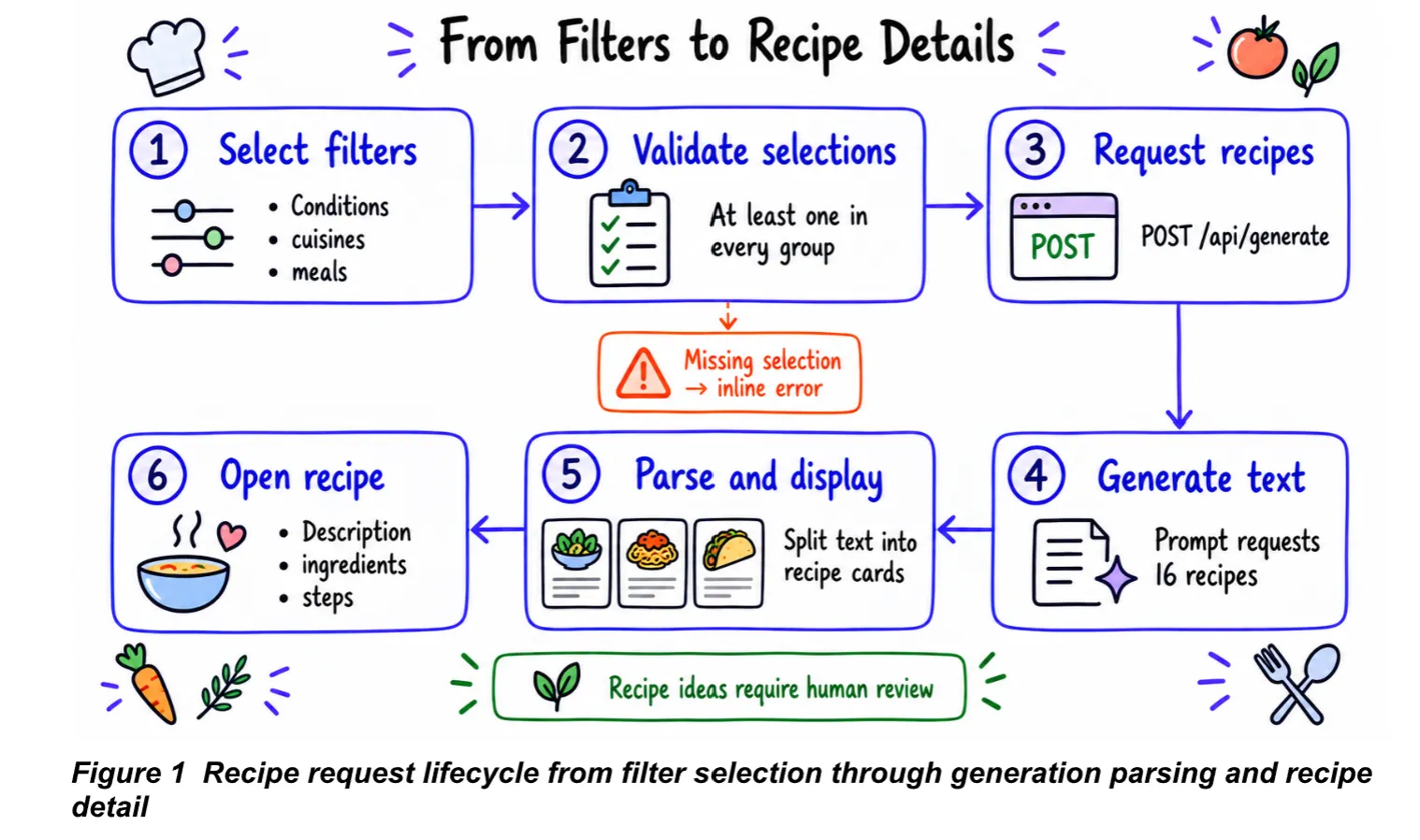
The interface works on both desktop and mobile devices, so recipes are easy to review at a desk or in the kitchen. The aim is simple: turn a handful of selections into practical meal ideas that can be prepared at home.Figure 1 shows the full request lifecycle, from selecting filters and validating that each group has a choice, through generating and parsing the recipe text, to opening an individual recipe.
Recipe Recommender considers the selected health condition, but AI-generated dietary suggestions have real limits that users should understand.
The application does not clinically verify ingredients, calculate validated nutritional values, or guarantee that a recipe meets an individual’s medical requirements. Dietary needs also vary widely among people with the same diagnosis. Guidance for kidney stones depends partly on the type of stone, and people with Crohn’s disease may tolerate different foods depending on their symptoms and disease activity.
Recipe Recommender is designed to support recipe exploration, not to replace the advice of a physician or registered dietitian. Users should check generated ingredients against their own dietary requirements before preparing any meal.
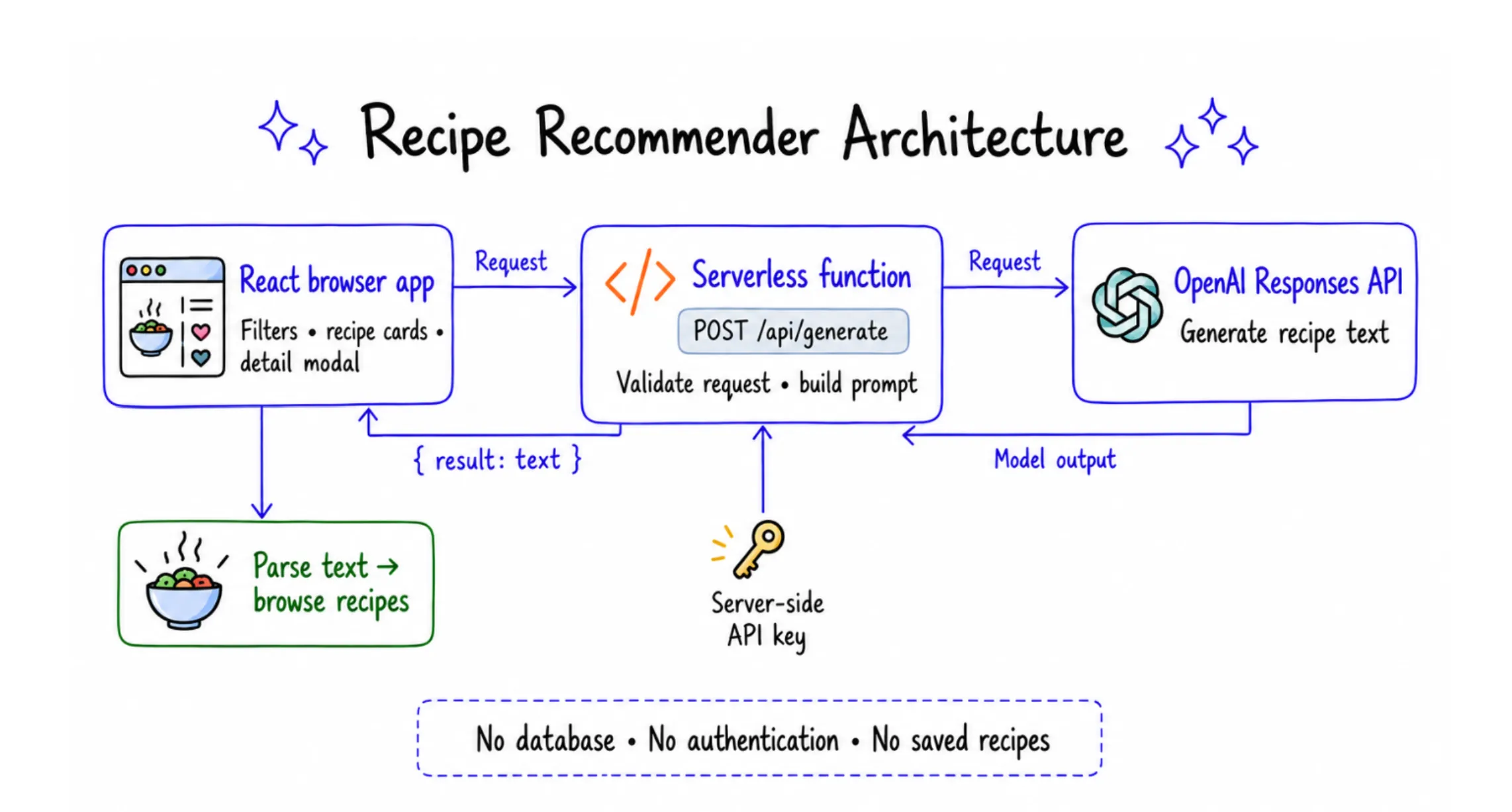
Recipe Recommender shows how AI can be woven into a practical, lightweight web experience. Its architecture has three main parts:
The result is an interactive experience with recipe cards, ingredient lists, and cooking instructions, delivered without a database, user accounts, or saved recipes. By pairing AI text generation with a clean, user-friendly interface, the application demonstrates how generative AI can be integrated into a simple and interactive web application..
Today, the application focuses on generating and displaying recipes. Several enhancements could extend its value:
Together, these improvements would give people even greater control over their everyday food choices.
Recipe Recommender was an opportunity to explore how generative AI can be integrated into a working application. From designing the user experience to connecting the AI model through a serverless backend, the project brought together several aspects of modern application development.
It also highlighted an important consideration when building AI applications. Generating a useful response is only one part of the challenge. Reliability, validation and understanding the limitations of AI are equally important..
Try Recipe Recommender: recipe-rec.vercel.app
About the Author Archit Singh is a 12th-grade student at Health Careers High School in San Antonio, Texas. As an intern with Intellious Technologies, he built Recipe Recommender, gaining hands-on experience in applied AI and web development while creating a tool that makes everyday cooking decisions easier for people with dietary health needs.
This application was developed as a student internship project and is not a commercial Intellious solution or a source of medical or dietary advice.




